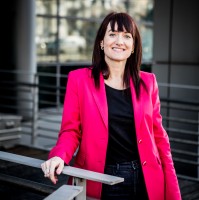
For the second year in a row, Agoria will have a platform at Advanced Engineering to strengthen the role and visibility of women in the technological, industrial and engineering sectors with a Women in Tech programme. During a panel discussion, women in different roles will discuss the importance of diverse perspectives in the workplace. Laurence Jacobs will act as moderator and make a clear link between diversity in the workplace, innovation and the ability to respond to market needs.
Agoria is a sector federation that represents and defends technology companies. The organisation offers a wide range of services that members can call upon, lobbies for their interests at both national and international level, and brings companies into contact with each other to stimulate cooperation.
One of the challenges within the sector remains the representation of women. “Only 22% of employees in the industrial sector are women, and in management positions, that figure is barely 19%,” says Laurence Jacobs, Manager Member Relations at Agoria. “However, proper representation offers clear advantages in terms of innovation, product development and business operations. With our Women in Tech programme, we want to boost that figure.”
Top women on the Main Stage
With the Women in Tech programme at Advanced Engineering, Laurence and Agoria want to actively change this. During the panel discussion ‘Next-Gen Engineering: diverse perspectives driving innovation’, they will bring three top women to the table, each with a different background and expertise.
“The first to join us is Tine Peeters, partner at Superellipse. She has a background in languages and has been working as a partner at a design agency for many years. Next is Tongtong Zheng, Senior R&D Manager at Onespan, who has a master’s degree in engineering and a focus on AI. Finally, we introduce Julie Vastmans, who has a PhD in Biomechanics and is Team Leader Engineering Digitalisation at Atlas Copco.”
These are very diverse profiles, which is exactly the intention, according to Laurence: “Innovation does not arise within your own silo, with a homogeneous team, but at the intersection of different perspectives. While Tine will focus more on the human aspect, Tongtong will start from data processing, and Julie will look at things from an industrial perspective.”
The panel discussion is open to all visitors. It will be followed by a networking opportunity for women active in the sector. “We hope that women will be able to exchange experiences and expand their network.”
Diversity = innovation
That message is at the heart of the conversation: diversity drives innovation. “Today’s challenges are no longer purely technical; they also involve humanity, understanding, sustainability and economic relevance,” Laurence explains.
"Giving space to and supporting different ways of thinking increases the collective intelligence of your team."
And how do you ensure that your team can handle these challenges? By consciously making room for diversity within your organisation, so that different ideas can be heard and utilised.
“Different ways of thinking shape innovation,” Laurence explains. “And by giving those different ways of thinking a place and supporting them, you increase the collective intelligence of your team. That leads to real innovation.”
“Take product development, for example: someone with knowledge of ergonomics can prevent physical strain from being overlooked. In app development, someone with a background in psychology can help understand why users drop out or keep coming back. And in AI applications, a lawyer can point out ethical and regulatory risks as early as the design phase. By bringing these perspectives together, innovation shifts from purely technical to sustainable, usable and socially relevant.”
Of course, this diversity goes beyond just men and women: culture, ethnicity, education and background also play a role.
How do you encourage diversity?
How does a company actually put this idea into practice? The problem often lies in motivating and retaining women within the sector, says Laurence: “Many more women are finding their way into the sector, but they drop out after a while. This is because their expertise is not recognised, they do not have access to equal opportunities, there is little female representation, or because they are not supported in combining work with family life – where the majority of care responsibilities still often fall to women.”
“If you want to develop products that meet the needs of a diverse society, you need to see that diversity reflected within your own organisation.”
As a business manager, it is therefore advisable to take a critical look at who makes the decisions. Who makes the final decisions? Who has an impact? Are these often the same profiles? And do these profiles listen equally to every voice in the company?
Ensuring that there is sufficient room for different profiles within your team not only helps your employer branding – and provides an answer to the war for talent – but also brings you closer to the needs of your users. “Society is becoming increasingly diverse. Anyone who wants to develop products and services that reflect this diversity must also see that diversity reflected within their own organisation,” concludes Laurence.
A sharp and inspiring discussion about diversity, directly linked to innovation. An invitation to take a critical look at your own team and organisation. This is an absolute must for business leaders who want to build sustainably and future-proof their organisations. The Agoria panel discussion, moderated by Laurence Jacobs, can be followed on Wednesday 6 May from 12 noon to 1 p.m. on the Main Stage of Advanced Engineering at Flanders Expo Ghent.