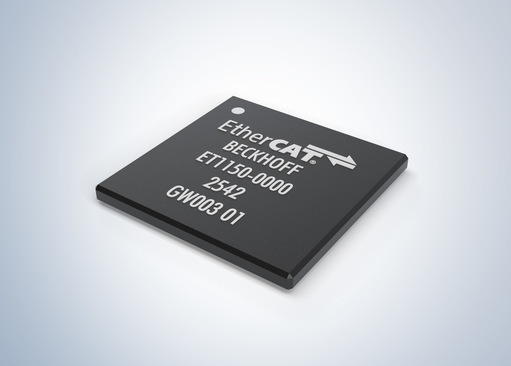
Beckhoff continues the EtherCAT success story: new chips and technology products support the global EtherCAT community and consistently raise the product to a higher level.
EtherCAT has established itself as the market leader with approximately 100 million installed nodes – and that’s not even counting the bus terminals. Developed by Beckhoff and introduced in 2003, the technology wins customers over with its exceptional performance and unique simplicity. It is not without reason that EtherCAT is considered the most important Ethernet fieldbus. Users appreciate the fact that an EtherCAT system is largely self-configuring: there is no need to set node addresses and the topology is not limited as it is with switched Industrial Ethernet systems.
One of the most important unique selling points of Beckhoff technology is its stability. Although new functions are constantly being added, the established functions never change. This means that there are no version problems: today’s devices work perfectly in EtherCAT systems from 2005 – and vice versa. This compatibility also applies to the new EtherCAT SubDevice Controller (ESC) chips and IP cores. They are backward and even drop-in compatible with their predecessors, although they offer significant improvements.
A completely newly developed source code significantly increases the performance of the process data interface (PDI) to the host control; a second PDI is also available that can be used in parallel. In addition, the energy consumption of the ET1150 chips has been reduced by 80%. This chip generation also continues to rely on the 100 Mbit physical layer, which forms the basis of EtherCAT technology. Thanks to its special functional principle, EtherCAT delivers higher performance than switch-based gigabit systems, even at 100 Mbit. In addition, 100BASE-TX is more robust, more resistant to interference, simpler and more cost-effective than gigabit physical layers.
EtherCAT G, the gigabit extension of EtherCAT, is therefore reserved for the rare applications that require even more bandwidth – for example, Beckhoff’s intelligent XPlanar transport system. However, EtherCAT G is not a new version and does not represent a break in the technology. Thanks to the new branch control technology, 100-Mbit segments can be seamlessly integrated into a gigabit network and benefit from improved performance thanks to parallel processing. Beckhoff is thus making EtherCAT fit for the next 20 years while benefiting from the growing global demand for this technology.
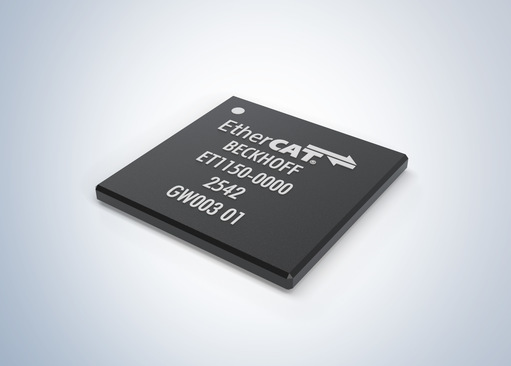
The ET1150 EtherCAT ASIC presented at SPS 2025 is just one example of the ongoing further development of EtherCAT technology.